Global Success Stories of Virtual Reality (VR) in the Mining Industry
How the World's Leading Mining Companies are Transforming Safety, Training, and productivity with Virtual Reality
Introduction
Mining is widely recognized as one of the world's most hazardous and operationally complex industries. Even minor human errors or equipment failures can lead to severe safety incidents, costly operational disruptions, and significant financial losses. As mining operations become increasingly sophisticated, conventional classroom-based training alone is no longer sufficient to prepare personnel for the challenges of modern industrial environments. In recent years, Virtual Reality (VR) has emerged as a transformative technology for industrial training, enabling organizations to create highly immersive, realistic, and completely risk-free learning environments. Through VR simulations, operators can practice real-world tasks, experience equipment malfunctions, respond to emergency situations, and learn from potential mistakes—all without exposing personnel, machinery, or production assets to actual danger. Recognizing these advantages, many of the world's largest mining companies have integrated VR into their workforce development strategies, making immersive learning a core component of employee training, operational safety, and technical skill development. Their experiences demonstrate that Virtual Reality is far more than an innovative training tool—it has become a strategic investment for reducing operational risk, improving workforce competency, and enhancing productivity across mining operations.
Rio Tinto: Training Heavy Equipment Operators in a Risk-Free Environment
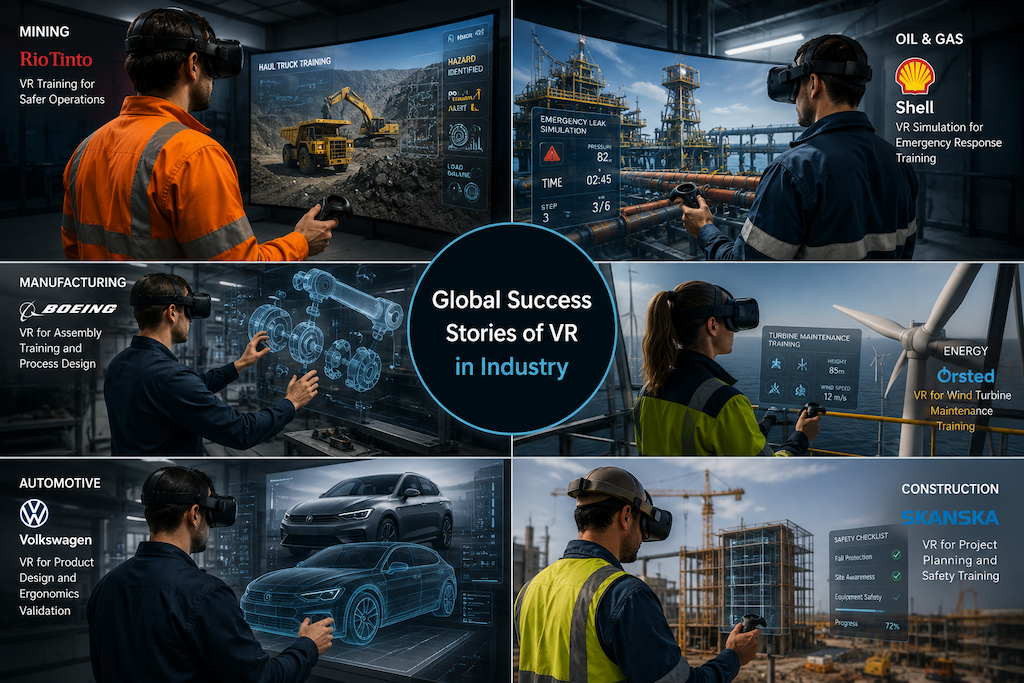
Rio Tinto, one of the world's leading mining companies with extensive operations across Australia and other regions, has been an early adopter of Virtual Reality for workforce training. Operating heavy mining equipment such as haul trucks, loaders, and drilling machines requires extensive hands-on experience. Traditionally, this training has been conducted in live operational environments, where mistakes can damage expensive equipment, disrupt production, and jeopardize worker safety. To address these challenges, Rio Tinto developed immersive VR training simulators that accurately replicate real mining operations. Within these virtual environments, trainees can safely learn equipment controls, practice operational procedures, and experience a wide range of workplace scenarios before entering an active mine site. The simulations also expose operators to human errors, equipment malfunctions, and emergency situations, allowing them to develop confidence and decision-making skills in a completely safe environment. The company has reported that employees who complete VR-based training enter field operations with higher levels of preparedness, resulting in fewer operational errors during the early stages of deployment and a smoother transition to real-world responsibilities.
BHP: Strengthening Mine Safety Through Immersive Learning
As one of the world's largest mining companies, BHP has adopted Virtual Reality to strengthen its safety culture and improve workforce preparedness. Rather than relying solely on theoretical instruction, BHP immerses employees in realistic simulations of mining hazards, including wall collapses, heavy equipment interactions, equipment failures, and emergency response scenarios. This immersive approach enables workers to experience the consequences of unsafe decisions in a controlled environment, creating a far deeper understanding of workplace risks than traditional classroom training. By actively participating in these realistic situations, employees not only learn established safety procedures but also improve their situational awareness, critical thinking, and emergency decision-making capabilities. The implementation of VR has also helped BHP standardize safety training across multiple mining sites while ensuring that new employees and contractors receive consistent, high-quality instruction before beginning field operations.
Vale: Simulating Mining Operations and Emergency Response
Vale uses Virtual Reality to train employees across a wide range of mining activities, including mineral extraction, material transportation, and emergency management. Following several major mining incidents around the world, emergency preparedness has become an increasingly important priority for the global mining industry. In response, Vale has developed realistic VR scenarios that allow employees to practice emergency evacuations, respond to equipment-related incidents, and manage abnormal operating conditions before facing them in real life. These immersive simulations provide workers with valuable opportunities to rehearse decision-making processes, evaluate different response strategies, and improve coordination during high-pressure situations. As a result, employees develop greater confidence, faster reaction times, and stronger operational readiness, enabling teams to perform more effectively when real emergencies occur.
Anglo American: Transforming Technical and Maintenance Training
Anglo American leverages Virtual Reality to enhance technical training and maintenance education across its mining operations. Modern mining equipment is highly sophisticated, making hands-on training with operational machinery both costly and time-consuming. Taking equipment out of service for training can also impact productivity and increase operational expenses. To overcome these challenges, Anglo American has implemented immersive VR training environments built on detailed 3D models of mining equipment. These virtual simulations allow technicians to repeatedly practice maintenance procedures, equipment inspections, troubleshooting, and repair workflows without interrupting production or exposing personnel to unnecessary risks. The ability to repeat complex procedures in a realistic virtual environment helps employees develop practical skills, improve confidence, and retain knowledge more effectively before working on actual equipment. By incorporating VR into its technical training programs, Anglo American has shortened training cycles, improved workforce competency, and replaced a significant portion of expensive instructor-led practical sessions with scalable immersive learning experiences.
Caterpillar: Enhancing Operator Training Through Virtual Reality
As one of the world's leading manufacturers of mining equipment, Caterpillar uses Virtual Reality not only to support its internal training initiatives but also to educate customers and equipment operators worldwide. Through immersive VR simulations, operators learn how to safely operate heavy machinery, perform daily inspections, identify potential equipment issues, and respond appropriately to abnormal operating conditions. Unlike traditional classroom instruction, VR enables users to interact directly with equipment in realistic operating scenarios, accelerating learning while improving knowledge retention and operational confidence. Beyond operator education, Caterpillar also utilizes Virtual Reality to showcase new machinery, demonstrate product capabilities, and provide customers with immersive product experiences before equipment deployment or purchase. This approach has reduced training costs, accelerated user onboarding, and strengthened customer engagement by allowing operators to gain practical experience in a completely safe environment.
A Common Lesson from Global Mining Leaders
The experiences of the world's leading mining companies reveal a consistent trend: the adoption of Virtual Reality is not driven simply by the desire to embrace emerging technology. Instead, it is a strategic initiative aimed at improving workforce safety, strengthening operational performance, reducing training costs, and minimizing operational risks. VR enables organizations to recreate situations that are either too dangerous, too expensive, or too disruptive to conduct in real-world environments. Employees can repeatedly practice critical procedures, experience emergency scenarios, and develop the confidence needed to respond effectively under pressure—all without jeopardizing people, equipment, or production. As a result, Virtual Reality has evolved from an innovative training solution into a core component of modern mining workforce development. Today, many of the industry's leading organizations consider immersive learning an essential part of safety management, technical training, operational excellence, and long-term digital transformation. Organizations that invest in VR-based industrial training are not simply adopting new technology—they are building safer workplaces, developing more capable employees, and creating more resilient mining operations for the future.