How to Improve Employee Preparedness for Emergency Situations
Modern Industrial Safety Training Solutions for More Effective Emergency Response
Introduction
Industrial incidents are an inherent part of complex operational environments. However, the level of employee preparedness for emergency situations often determines whether an incident is contained quickly or escalates into a major crisis. In industries such as steel manufacturing, oil and gas, petrochemicals, power generation, and mining, hazards including gas leaks, fires, explosions, hazardous material releases, equipment failures, and other high-risk activities represent some of the most significant safety challenges. Experience from industrial accidents has consistently shown that the severity of an incident is not determined solely by its initial cause. The actions taken by employees during the critical first moments—how quickly they recognize the situation, make decisions, follow established emergency procedures, and coordinate their response—have a direct impact on minimizing injuries, preventing operational disruption, and reducing financial losses. For this reason, leading organizations no longer view safety training as merely a regulatory requirement or the sole responsibility of the HSE department. Instead, they recognize it as a strategic investment that strengthens organizational resilience, protects the workforce, and reduces operational risk across the enterprise. Effective preparedness is achieved when employees have the opportunity to experience realistic emergency scenarios, practice appropriate response procedures, and evaluate their performance before encountering an actual emergency. While traditional safety training methods—such as classroom instruction, presentations, and written procedures—remain essential for building foundational knowledge, they cannot fully prepare personnel to make the right decisions under pressure in dynamic and unpredictable situations. This growing challenge has driven industries toward modern simulation-based safety training solutions. By recreating realistic emergency scenarios in a safe and controlled environment, these technologies enable employees to develop practical skills, improve decision-making, evaluate their responses, and enhance operational readiness—all without exposing personnel, equipment, or facilities to real-world hazards.
Why Is Employee Preparedness for Emergency Situations So Important?
During an industrial emergency, employees' initial actions play a critical role in containing the situation and preventing it from escalating. Rapid hazard recognition, timely incident reporting, selecting safe evacuation routes, using emergency equipment correctly, and maintaining effective coordination with team members are all essential factors that contribute to successful emergency response and crisis management. However, human performance during an emergency rarely reflects normal working conditions. Psychological stress, time pressure, reduced situational awareness, and rapidly evolving circumstances can significantly affect decision-making. As a result, employees may struggle to apply theoretical knowledge alone when faced with a real-life emergency. For example, an employee who has only attended classroom training on gas leaks, fire emergencies, or equipment failures may find it difficult to respond appropriately when confronted with a sounding alarm, visible smoke, or an uncertain and rapidly changing situation. In contrast, personnel who have previously experienced similar scenarios within a realistic simulation environment are generally better prepared to respond calmly, confidently, and effectively. Practical exposure to emergency scenarios enables employees to develop more than just hazard awareness. It allows them to practice appropriate response procedures, prioritize critical actions, improve decision-making under pressure, and build the confidence needed to perform effectively in high-risk situations. For this reason, the primary objective of emergency preparedness training extends beyond transferring knowledge or familiarizing employees with procedures. Its true purpose is to develop practical competence, strengthen critical decision-making skills, and transform correct emergency responses into instinctive behaviors that can be executed effectively when real incidents occur.
Limitations of Traditional Safety Training in High-Risk Industries
Conventional safety training methods—including classroom instruction, reviewing operating procedures, watching training materials, and conducting periodic emergency drills—remain essential components of HSE programs across industrial organizations. These approaches are effective for delivering fundamental safety knowledge, familiarizing employees with regulatory requirements, and explaining standard operating procedures. However, as industrial processes become more complex and workplace hazards more diverse, the limitations of traditional training methods have become increasingly apparent. One of the most significant challenges is the gap between knowing and performing. An employee may thoroughly understand emergency response procedures in theory, yet struggle to execute the correct actions when confronted with a real emergency characterized by stress, time pressure, and rapidly changing conditions. Theoretical instruction on scenarios such as gas leaks, explosions, process equipment fires, or emergency evacuations provides valuable knowledge, but it does not replicate the practical experience of responding to these events in real time. Consequently, employees may lack the confidence and decision-making ability required when every second matters. Moreover, recreating many critical emergency scenarios in an actual industrial environment is often impractical or impossible. Simulating events such as major explosions, large-scale fires, hazardous gas releases, or incidents within operating process units involves significant financial costs and can introduce additional risks to personnel, equipment, and ongoing operations. For these reasons, organizations operating in high-risk industries increasingly recognize that traditional safety training alone cannot fully prepare employees for complex emergency situations. Developing true operational readiness requires immersive, experience-based learning that enables personnel to practice realistic emergency scenarios without exposing people or assets to unnecessary danger.
As a Result, Industrial Organizations Face a Fundamental Challenge:
How can employees be prepared for situations that cannot be safely practiced in a real workplace environment?
Addressing this challenge requires a shift toward experience-based training approaches and the adoption of advanced technologies such as Virtual Reality (VR) and Augmented Reality (AR). These technologies enable organizations to recreate critical emergency scenarios, allow employees to practice appropriate responses, and evaluate their performance in a safe and controlled environment—without exposing personnel, equipment, or facilities to real-world risks.
Key Characteristics of an Effective Emergency Preparedness Training Program
An effective safety training program must go beyond simply transferring information. It should prepare employees to make the right decisions and take timely actions when facing critical situations. Achieving this goal requires designing training programs based on an organization’s actual risks and ensuring a direct connection between training scenarios and employees’ operational environments. The nature of industrial hazards varies significantly across different sectors. In the steel industry, scenarios such as natural gas leaks, carbon monoxide releases, hydrogen leaks, equipment fires, gas accumulation explosions, working at height, and confined space operations are among the critical situations that require continuous employee preparedness and practice. Similarly, in the oil, gas, and petrochemical industries, hazards including chemical leaks, storage tank fires, toxic gas releases, process equipment failures, and emergency evacuations require specialized training and operational readiness. Therefore, emergency preparedness training content should be developed based on real operational processes, available equipment, and the specific risk profile of each organization. When employees can clearly see the connection between training scenarios and actual workplace conditions, their engagement, learning effectiveness, and ability to apply acquired skills significantly improve. Emergency preparedness is also an ongoing process that cannot be achieved through a single short-term training session. Regular practice, repeated scenario-based exercises, employee performance evaluation, and continuous improvement of training processes are essential components of an effective industrial safety training system.
Why Is Virtual Reality Effective in Emergency Preparedness Training?
The most significant advantage of Virtual Reality (VR) in safety training is its ability to provide employees with a realistic and immersive experience within a completely controlled environment. This technology allows personnel to encounter scenarios that cannot be safely or practically recreated in the real world due to their high level of risk, operational limitations, or significant costs—without creating any danger to people, equipment, or production processes. For example, an operator can experience scenarios such as gas leaks, equipment fires, operational system failures, or emergency evacuations, and practice making the appropriate decisions required to manage each situation effectively. This hands-on learning experience enables employees not only to develop a better understanding of potential hazards but also to build the practical skills and response capabilities needed to act correctly during critical emergency situations. By repeatedly practicing realistic scenarios, personnel can improve their confidence, decision-making ability, and readiness for real-world incidents.
Key Benefits of Using Virtual Reality in Industrial Safety Training
The most important advantages of using Virtual Reality (VR) in industrial safety training include the following:
Experiencing Critical Situations Without Creating Real Risks
Due to their high-risk nature, some industrial scenarios cannot be safely conducted or repeatedly practiced in real working environments. Virtual Reality enables employees to experience these situations multiple times and practice their responses without affecting personnel safety or disrupting production processes. By recreating realistic emergency conditions in a controlled virtual environment, organizations can provide employees with valuable hands-on experience while eliminating the risks associated with real-world training exercises.
Improving Learning Retention
Learning becomes significantly more effective when individuals actively participate in the training process. In VR-based training, users are not merely passive recipients of information; they must make decisions, perform actions, and observe the consequences of their choices. This direct interaction creates a deeper learning experience, helping employees retain safety concepts more effectively and apply their knowledge more confidently when facing real emergency situations.
Unlimited Scenario Repetition and Practice
One of the limitations of real emergency drills is the difficulty of repeating complex scenarios frequently. Operational costs, potential disruption to production activities, and safety constraints often limit the number of practical exercises that can be conducted in real environments. In contrast, virtual environments allow emergency scenarios to be repeated as many times as necessary, enabling employees to continuously practice their skills and improve their readiness until they reach the required level of competency.
Accurate Evaluation of Employee Performance
One of the key capabilities of VR-based training systems is the ability to record and analyze user performance. Factors such as response time, decisions made, selected actions, chosen routes, errors, and overall performance outcomes can be captured and evaluated as valuable data for improving training programs. This capability allows organizations to move beyond measuring safety training effectiveness based only on attendance and provides a more accurate understanding of employees’ actual preparedness for emergency situations.
Applications of Virtual Reality in Industrial Emergency Scenario Simulation
One of the most valuable capabilities of Virtual Reality in industrial safety training is the ability to design and implement training scenarios tailored to the actual conditions of each organization. These scenarios can be developed based on operational processes, available equipment, workplace environments, and identified risks within each industry, allowing employees to gain realistic experience in responding to emergency situations.
Simulation of Gas Leaks and Hazardous Material Releases
In this scenario, employees encounter situations such as detecting a leak, activating emergency notifications, correctly using personal protective equipment (PPE), communicating with responsible departments, and safely evacuating the affected area. The primary objective of this type of training is to improve response speed, enhance decision-making during the initial moments of an incident, and reduce the likelihood of human errors in critical situations.
Simulation of Industrial Equipment Fires
Fire incidents are among the most significant safety risks across many industries. In a Virtual Reality environment, situations such as identifying early warning signs of fire, assessing the conditions, selecting appropriate response methods, and coordinating with emergency response teams can be simulated. This type of training enables employees to experience challenging conditions—such as reduced visibility, limited response time, psychological pressure, and the need for rapid decision-making—before facing an actual emergency. As a result, they develop greater confidence and readiness to manage critical situations effectively.
Training for Explosion Response and Process Emergency Situations
In process industries, incidents such as explosions or sudden energy releases can rapidly change workplace conditions and require immediate, coordinated responses from employees. Using Virtual Reality to simulate these situations allows personnel to practice initial emergency actions, identify safe evacuation routes, and develop appropriate response behaviors before encountering a real incident.
Working at Height and Confined Space Safety Training
Working at height and entering confined spaces are among the activities associated with significant safety risks and require strict compliance with safety procedures. Virtual Reality can create realistic environments where employees practice hazard identification, safe work methods, and emergency response procedures related to these activities before performing actual operations. This approach helps improve safety awareness, reduce human error, and increase operational preparedness in high-risk work environments.
The Role of Augmented Reality (AR) in Enhancing Operational Safety
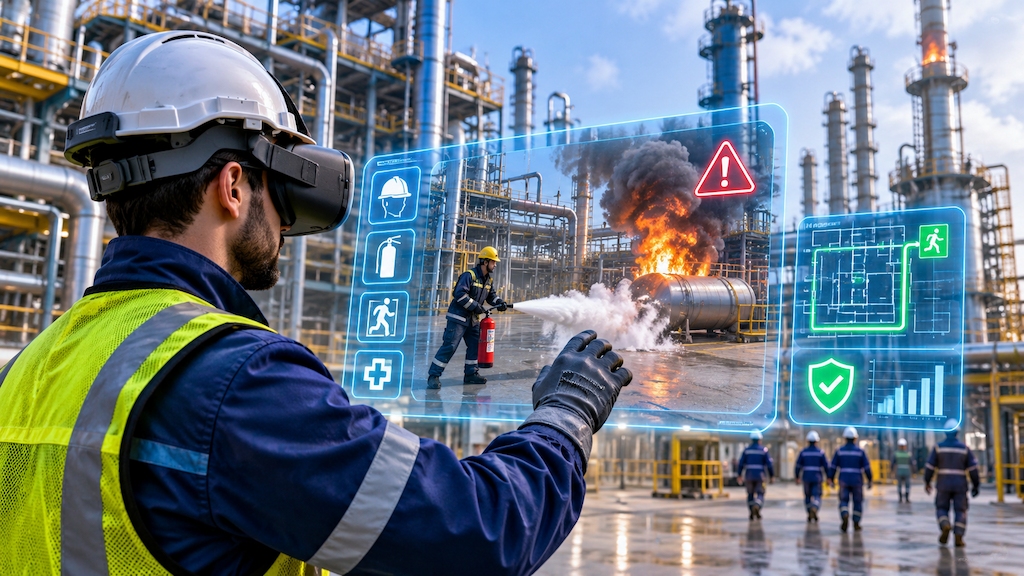
While Virtual Reality (VR) is primarily used for training, simulation, and practicing emergency situations before they occur, Augmented Reality (AR) can support employees during actual operations by providing real-time assistance in the workplace. By overlaying digital information onto the real-world environment, AR technology enables users to access required data faster and more accurately. This information can include work instructions, equipment specifications, safety warnings, maintenance guidelines, and operational support content. For example, a maintenance technician working on-site can use AR to view technical information, step-by-step procedures, and safety considerations related to a specific piece of equipment. This allows maintenance, inspection, and troubleshooting activities to be performed with greater accuracy and reduced risk of human error. In emergency situations, AR can also contribute to safer and more effective responses by displaying safe evacuation routes, providing step-by-step instructions, and enabling remote communication with technical experts. These capabilities help employees make better decisions, especially in complex situations where quick access to reliable information is critical. The integration of Virtual Reality and Augmented Reality creates a comprehensive approach to improving safety in industrial environments. In this approach, employees use VR environments to experience critical scenarios and develop the necessary response skills, while AR supports them during real
operations by providing access to relevant information, safety alerts, and operational guidance when and where they need it.
The Future of Industrial Safety Training: Moving Toward Smart Learning
Digital transformation in industries is no longer limited to production processes, equipment maintenance, and operational optimization. It is also reshaping the way organizations train their workforce, develop skills, and prepare employees for complex operational challenges. In the coming years, organizations seeking to reduce operational risks and enhance workforce preparedness will increasingly move toward interactive, simulation-based, and data-driven training approaches. Technologies such as Virtual Reality (VR), Augmented Reality (AR), Artificial Intelligence (AI), and data analytics are enabling safety training to evolve from a standardized approach for all employees into a smart and personalized learning experience tailored to individual needs. In traditional training models, a fixed educational content is typically delivered to a large group of employees regardless of differences in experience, skill level, or learning requirements. However, in smart training environments, each user’s performance can be monitored and analyzed, allowing the learning path to be adjusted based on individual weaknesses, competency levels, and specific training needs. For example, if an employee participating in a simulated gas leak scenario makes mistakes in identifying the source of the hazard, selecting a safe route, or performing initial emergency actions, these performance data can be recorded and analyzed. Based on this information, targeted improvement programs and additional training sessions can be developed to address specific skill gaps. This approach enables organizations to move beyond simply conducting safety courses and toward a more effective safety management model—one that measures the actual preparedness of employees and uses data-driven insights to continuously improve skills, strengthen emergency response capabilities, and reduce operational risks.
The Role of Simulation-Based Training in Reducing Human Error
Human factors remain one of the most critical elements influencing the occurrence or prevention of industrial incidents. Even in organizations equipped with advanced safety systems and control technologies, employee decisions and actions during critical moments can have a direct impact on the outcome of an emergency. Many human errors do not occur due to a lack of knowledge; rather, they result from insufficient practical experience in dealing with abnormal conditions and high-pressure situations. Employees may understand safety procedures theoretically but still struggle to apply them effectively when faced with unexpected events that require rapid decisions and immediate responses. Simulation-based training addresses this challenge by providing employees with realistic practice environments where they can develop the skills required for effective decision-making and emergency response before encountering an actual incident. This type of training allows employees to experience the consequences of their decisions, identify correct priorities under stressful conditions, and build greater confidence when responding to critical situations. By repeatedly practicing realistic scenarios, personnel can improve their situational awareness and develop more effective response behaviors. As a result, organizations can reduce the likelihood of human error, enhance operational safety, and strengthen workforce preparedness for managing industrial emergencies.
Frequently Asked Questions About Employee Emergency Preparedness Training
Why Is Employee Preparedness for Emergency Situations Important?
Employee preparedness enables personnel to make faster and more accurate decisions during the initial moments of an incident. An effective response in the first few minutes can significantly reduce human, financial, and operational losses and help prevent the escalation of an emergency.
Are Traditional Training Methods Sufficient for Preparing Employees?
Traditional training methods, including theoretical courses, reviewing safety procedures, and conducting emergency drills, remain important components of organizational training programs. However, developing practical skills and preparing employees to handle complex emergency situations requires more interactive approaches, such as simulation-based training and Virtual Reality, to improve overall training effectiveness.
How Does Virtual Reality Support Industrial Safety Training?
Virtual Reality creates immersive three-dimensional environments that replicate real-world conditions, allowing employees to practice high-risk scenarios without exposing themselves or equipment to actual danger. In a controlled virtual environment, users can develop decision-making skills, practice emergency responses, and learn the correct use of safety equipment.
What Emergency Scenarios Can Be Trained Using Virtual Reality?
A wide range of scenarios can be simulated and trained through Virtual Reality, including gas leaks, industrial equipment fires, explosions, emergency evacuations, working at height, confined space operations, process-related incidents, and responses to hazardous material releases.
What Is the Difference Between Virtual Reality and Augmented Reality in Industrial Training?
Virtual Reality is primarily used to create fully simulated environments for training and preparing employees before performing actual operations. In contrast, Augmented Reality enhances the real-world environment by overlaying digital information, enabling employees to access operational guidance, technical data, and safety instructions during activities such as maintenance, inspection, and equipment operation.
Conclusion: From Traditional Training to Smart Emergency Preparedness
Enhancing employee preparedness for emergency situations is one of the key requirements in high-risk industries. Experience from industrial incidents has demonstrated that the presence of safety procedures and advanced protective equipment alone cannot guarantee effective crisis management. Employees must have the opportunity to experience critical situations, practice appropriate responses, and evaluate their performance before an actual incident occurs. Traditional training methods continue to play an important role in HSE management systems. However, limitations such as the difficulty of conducting high-risk scenarios, the inability to repeatedly perform certain emergency exercises, and the lack of accurate evaluation of employees’ real performance have increased the need for advanced training approaches. Technologies such as Virtual Reality (VR) and Augmented Reality (AR) have created new opportunities for developing safe, interactive, and measurable training environments. Through these technologies, employees can experience various emergency scenarios, strengthen their decision-making and response skills, and achieve a higher level of readiness for critical situations. The future of industrial safety training is moving toward the integration of human experience with intelligent technologies. This approach can help organizations transition from reactive training models toward smart prevention, continuous assessment of workforce preparedness, and proactive risk management.